Why the Moon’s Shape Changes Through the Month
Why the Moon’s shape changes through the month becomes clear when you track its sunlight, position, and viewing angle. Learn to read the geometry.
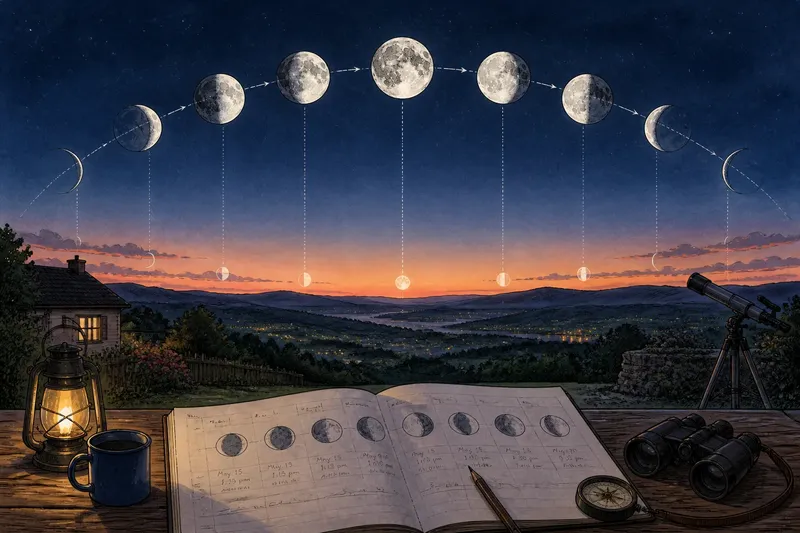
The most common mistake in reading the Moon is to treat its changing shape as Earth’s shadow crossing it. That explanation fits a lunar eclipse, but it fails for the familiar sequence of crescents, halves, and rounded Moons. Why the Moon’s shape changes through the month is a question of geometry: sunlight illuminates half the Moon, while our changing viewpoint lets us see different portions of that sunlit half.
The Moon keeps half of itself in sunlight
The Sun lights the side of the Moon facing it, just as it lights one side of a ball held near a lamp. The Moon is not making its own light. The bright part we see is sunlight reflected from its surface; the dark part is turned away from the Sun.
At any given moment, roughly half the lunar globe is sunlit. The phase describes how much of that illuminated half faces Earth. As the Moon travels around Earth, the direction from the Moon to the Sun changes relative to the direction from the Moon to us. We see the boundary between daylight and lunar night from a new angle.
That boundary is called the terminator. It is not a mark painted on the Moon, and it does not usually represent Earth’s shadow. It is the line where sunlight meets the lunar surface. Along it, craters and mountains can cast long shadows, which is why the Moon’s surface near the terminator often looks especially textured through binoculars or a telescope.
Imagine one month of observations from a backyard
Say you keep a simple observing record from a backyard and begin on an evening when a thin crescent hangs low in the western sky after sunset. You note the date, the direction, the time, and which side of the visible disk is bright. Over the following evenings, you look again from the same yard, without expecting the Moon to appear at the same hour each time.
At first, the illuminated portion grows from a narrow curve toward a half disk. The Moon is waxing, meaning the visible sunlit area is increasing. It also appears farther from the Sun’s direction in the sky, so it tends to remain above the horizon later into the evening. The crescent’s horns point generally away from the bright side; their exact tilt depends on where the Moon sits in the sky and the observer’s location.
After the first-quarter phase, more than half of the visible disk is lit. This is the waxing gibbous phase. The Moon can be visible well into the night, but its surface is not necessarily best described as “getting brighter” in a simple, uniform way: the visible area grows, while the angle of sunlight across the landscape also changes what surface details stand out.
Near full Moon, Earth lies roughly between the Sun and the Moon, and the side facing Earth is almost entirely sunlit. “Roughly” matters. If the alignment were exact, Earth’s shadow would fall across the Moon and produce a lunar eclipse. Most months the Moon passes a little above or below that shadow, so the disk looks full without being eclipsed.
In the days after full Moon, the lit portion shrinks. This is waning. A waning gibbous Moon rises later in the evening than a full Moon; near last quarter it shows a half disk again, then narrows to a waning crescent before reaching new Moon. The sequence has returned to its starting geometry, even though the Moon has continued along its orbit.
In this imagined record, the useful result is not a perfect drawing. It is a pattern: the phase, the Moon’s position relative to the Sun in the sky, and the time it is visible change together. A few dated sketches make that relationship easier to notice than trying to memorize a diagram.
The phase names describe the visible fraction
- New Moon: The Moon is near the Sun’s direction in the sky, with its sunlit side turned mostly away from Earth. It is difficult to see in ordinary evening observing.
- Waxing crescent: A slim illuminated curve appears after sunset and grows on successive evenings.
- First quarter: About half of the visible disk is illuminated, and the lit portion is increasing.
- Waxing gibbous: More than half is lit, approaching full Moon.
- Full Moon: The Earth-facing side is nearly all illuminated.
- Waning gibbous: The visible lit area is decreasing after full Moon.
- Last quarter: About half of the disk is illuminated again, now on the opposite side from first quarter.
- Waning crescent: A narrowing curve remains before the next new Moon.
“Quarter” refers to the Moon’s progress around Earth, not to a quarter of the disk being lit. At first quarter and last quarter, half of the visible face is illuminated. The names are a small trap laid by ordinary language, not by the Moon.
Why does the Moon rise at different times?
Why is a crescent usually seen after sunset?
A waxing crescent is near the Sun in the sky, so it sets not long after the Sun. It is visible in the west during twilight or early evening, with the bright edge facing the Sun’s direction.
Why does a full Moon rise near sunset?
At full Moon, the Moon is opposite the Sun in the sky. As the Sun sets in the west, the Moon is rising in the east, leaving it available for much of the night.
Why does the Moon look different in the Southern Hemisphere?
The phase sequence is the same, but the orientation of the bright portion appears rotated from what many Northern Hemisphere diagrams show. A sketch made from your own location records the view more reliably than a memorized “left” or “right” rule.
Does Earth’s shadow cause the monthly phases?
No. The phases come from our changing view of the Moon’s sunlit half. Earth’s shadow causes a lunar eclipse only when the Sun, Earth, and Moon align closely enough for the Moon to pass through that shadow.
A brief record makes the geometry visible
For the backyard observations in this invented situation, a notebook entry can stay simple: date, approximate time, phase shape, bright-side direction, and where the Moon sits relative to a familiar landmark. A phone compass can help with direction, though nearby metal and buildings can affect its reading. A sketch need only show a circle, the lit portion, and the terminator.
Compare entries made several evenings apart rather than expecting an obvious change from one night to the next. The Moon’s position shifts against the background sky, and its phase changes gradually. If clouds interrupt the sequence, note the gap and resume later; the geometry does not wait for a clear forecast.
One caution about orientation: the crescent’s tilt can change as it crosses the sky, and a photograph or chart may be rotated. Record which way is up in your own view, or include a landmark, rather than treating the crescent as a fixed icon.
Read the bright side before naming the phase
When you next see the Moon, first locate the bright side and consider where the Sun is, even if the Sun has already set. Then ask whether the illuminated area is growing or shrinking compared with a recent view. Those two observations are enough to distinguish the basic geometry from the misleading shadow explanation.
Why the Moon’s shape changes through the month becomes less mysterious once “shape” is understood as a changing view, not a changing object. The Moon remains a sphere; sunlight and orbital position do the rearranging. A small dated note can preserve the useful part of the observation: not just what the Moon looked like, but where the Sun had to be for it to look that way.