Binoculars or a Small Telescope for a First Look?
Binoculars or a small telescope can suit different first views: compare handling, field of view, and detail to choose a tool you will enjoy using.
The most common mistake in choosing binoculars or a small telescope is buying for magnification before deciding what you want to look at. The cost is often a narrow, shaky view of an object you cannot easily locate. For a first look, the useful question is simpler: would you rather sweep across a broad patch of sky, or settle on a smaller target and inspect it?
These are different ways of observing, not rungs on a ladder. Binoculars tend to make the sky easier to scan and keep familiar. A small telescope can show more detail in selected targets, but asks for more setup and aiming. Either can be a sensible first instrument if its habits suit yours.
Binoculars make the sky easier to sweep
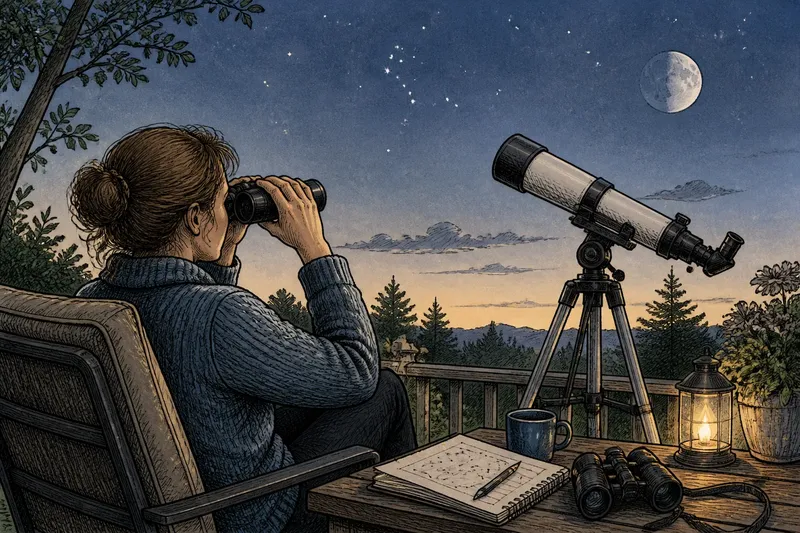
Binoculars are held with both hands and show an upright view through two eyepieces. Many observers find the two-eyed view comfortable and immediately legible. There is no separate finder to align, and the instrument can be pointed by looking along its barrels toward a bright target.
Their broad field of view is useful when the target is not a single obvious point. You can trace a star-rich stretch of sky, follow a loose grouping, or take in a large lunar region without constantly nudging the instrument. This wide view also makes orientation easier: nearby stars remain visible as landmarks rather than disappearing beyond the edge.
That breadth has a limit. A handheld pair magnifies hand movement along with the sky, so the image can tremble, especially when you hold your arms out. Resting your elbows on a chair arm or railing can help, though a railing should not become an invitation to lean over a drop. A reclining chair may let you support your arms and look upward without turning the session into a contest with your shoulders.
Binoculars are also easy to carry outdoors and put away. They can be a good match for someone who wants to move between broad sky views and terrestrial views in daylight. Check that the focus wheel turns smoothly and that the barrels adjust to fit the spacing of your eyes. If the two images do not merge comfortably, the view may become tiring even when the sky is clear.
A small telescope favors chosen targets
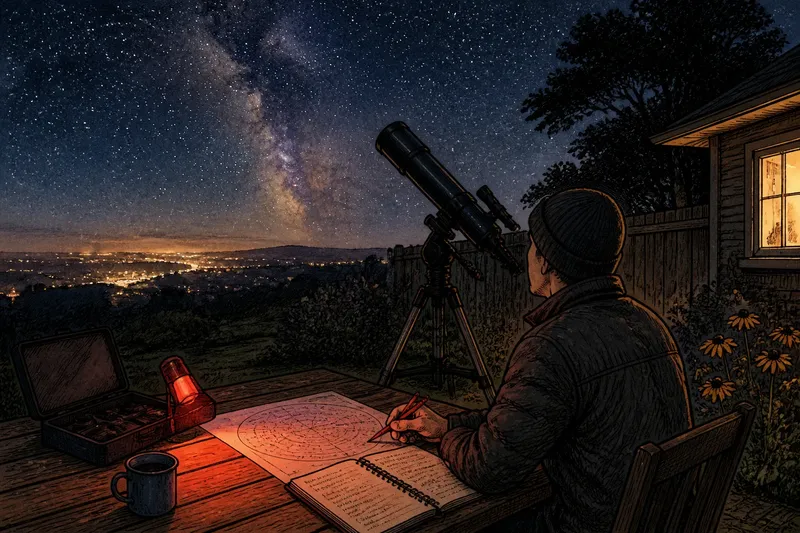
A small telescope gathers light through one main optical tube and presents its view through an eyepiece. It is normally supported on a tripod or mount. That support matters: a stable instrument is easier to aim and keep on target than a magnified view held in midair.
Telescopes commonly offer interchangeable eyepieces, so the apparent scale and field can change with the chosen eyepiece. A shorter focal-length eyepiece often gives higher magnification and a narrower field; a longer focal-length eyepiece tends to show a wider area at lower magnification. The exact view depends on the telescope and eyepiece together. More magnification is not automatically more useful, since a narrow view can make locating and following a target harder.
A telescope can make lunar craters and other compact, bright targets easier to examine closely than they appear in binoculars. It can also show a planet as a small disk rather than a point, though the amount of visible detail depends on the instrument, the target’s position, atmospheric steadiness, and the observer’s expectations. Do not expect a small telescope to reproduce the large, sharp images printed on a box. Those images are illustrations, not a preview of the eyepiece.
Some small telescopes use a simple alt-azimuth mount, which moves up and down and side to side. That arrangement feels intuitive, though at higher magnification a target can drift out of view and require gentle repositioning. Other mounts have different controls and learning curves. Before choosing, look at how the telescope attaches to its tripod, whether the controls are easy to reach, and whether the assembled instrument has a place to stand without blocking doors or footpaths.
Field of view changes the character of the view
Field of view is the amount of sky visible at once. It is not just a technical specification; it shapes how observing feels. A wide view provides context, while a narrow view concentrates attention. Think of binoculars as looking through a broad picture window and a higher-power telescope view as peering through a small opening. The window gives you more surroundings; the opening makes one part the subject.
For star patterns and extended sky regions, context can be the point. A broad field helps preserve the relationships between nearby stars and makes it easier to move from one recognizable pattern to another. For a compact target, a narrower view can put attention where you want it, provided the target has first been found and the mount can keep it in view.
When comparing instruments, look for the stated field of view, but treat the number as a guide rather than a verdict. Telescope fields vary with the eyepiece, and binocular specifications may describe apparent or true field in different ways. If the listing is unclear, compare the instrument’s intended use and try to look through a similar setup at a local astronomy club event or an optics shop.
Which instrument suits your preferred first view?
Which is easier to point at the sky?
Binoculars are generally quicker to point because you can look along them and use the surrounding stars for orientation. A telescope’s finder and mount can make aiming precise, but they add parts to learn and adjust.
Which gives a wider view?
Binoculars often show a broad area at once, making them useful for sweeping and taking in star groupings. A telescope can also provide a wide view with a suitable eyepiece, but its field changes with the optical setup.
Which is better for examining the Moon?
Either can give a pleasing lunar view. Binoculars show a larger portion of the Moon with surrounding context, while a telescope can frame a smaller region for closer inspection.
Can one instrument do everything?
Neither tool excels at every kind of view. Binoculars favor mobility and breadth; a small telescope favors supported, more concentrated views, with the option to change eyepieces on many models.
Let your observing routine make the choice
Imagine you have a clear evening, a porch chair, and a wish to find a few bright patterns without carrying much equipment. Binoculars would likely fit that routine: you could sit, support your arms, and scan a broad area while keeping surrounding stars in view. The observable result would be a more contextual view, though small hand movements might still make it shimmer.
Now imagine the same observer mainly wants to examine the Moon from a fixed spot in the yard. A small telescope on a stable mount may fit better. The view would be more concentrated, and the observer would have to spend some time aiming and keeping the target in the eyepiece. The preference, not an abstract ranking, decides which inconvenience is acceptable.
Before buying, consider where the instrument will be stored and used. A telescope that is awkward to carry through a narrow doorway may stay indoors; binoculars that are comfortable to lift but difficult to hold steady may also see little use. Try the movement of the focus control, the eyepiece position, and the mount’s basic motions if possible. The instrument should feel manageable in the place where you plan to observe, not merely impressive on a shelf.
- Choose binoculars if broad views and quick setup matter more than close inspection.
- Choose a small telescope if you want to concentrate on compact targets and accept a mount and eyepiece routine.
- Favor a stable support if magnified views tend to feel unsteady.
- Check whether the instrument’s field suits the targets you expect to observe.
- Try the controls in person when possible, especially focus, eyepiece access, and mount movement.
For either option, read the maker’s instructions and product labels for compatibility, care, and any solar-viewing limits; never look at the Sun through optical equipment without a purpose-made solar filter fitted as specified by its manufacturer. Once those details are settled, binoculars or a small telescope becomes a question of preferred attention: a sky you can roam, or a target you can linger over.