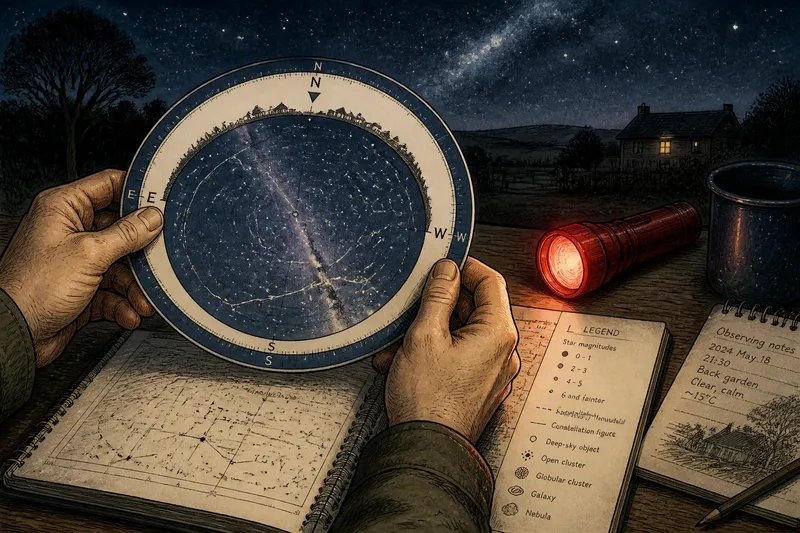
A Winter Window for Watching Orion
A winter window for watching Orion becomes a simple observing station: learn where to look, compare its position across evenings, and keep useful notes.
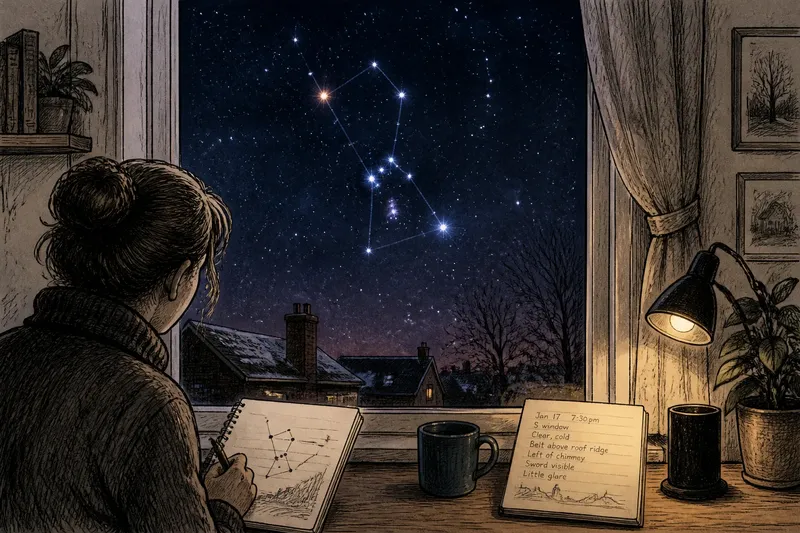
The common mistake in watching Orion from home is choosing the window first and asking questions later. A pane that faces the wrong part of the sky, or reflects a bright room, can turn a simple evening observation into a search for a constellation that is plainly somewhere else. A winter window for watching Orion works best when you treat it as a small, repeatable observing station.
You need no telescope, binoculars, or trip away from home. Pick a suitable view, learn Orion’s recognizable pattern, and note where it sits at roughly the same time on several clear evenings. The point is not to make a chart worthy of a ship’s cabin. It is to notice what the sky is doing from one ordinary window.
1. Choose a window with a useful view
Orion is prominent in winter evenings for observers across much of the Northern Hemisphere, but the direction and timing of its appearance vary with location and season. A south-facing window often gives a useful view, though an east- or west-facing one may suit the time you are available. Check the sky from indoors before settling on a spot: a roofline, tree, or neighboring building can hide the constellation at the height you want to observe.
Look for a window with a broad, unobstructed patch of sky rather than the largest pane in the house. A narrow view can still work if it includes Orion’s main stars. Avoid assuming the brightest patch of sky is empty; nearby streetlights and illuminated signs can wash out fainter stars, while the more conspicuous pattern may remain visible.
2. Reduce reflections before you start
Indoor light reflected in glass can compete with the stars. Turn off nearby lamps, move a bright screen out of the window’s reflection, and stand close enough to the pane that the room is less visible in it. If curtains or blinds can be drawn aside without blocking the view, use them. A dark cloth behind you can also reduce reflections, though it is a convenience rather than a requirement.
Give your eyes a little time to settle after looking at a bright phone or ceiling light. Keep the screen dim if you use a sky map, and switch it off while you look through the glass. Orion’s brighter stars are comparatively forgiving, but reflections can make even an easy pattern needlessly elusive.
3. Find Orion by its unmistakable belt
Start with the three bright stars arranged in a short, nearly straight row: Orion’s Belt. Above and below that line are brighter stars marking the shoulders and feet. The orange-tinted star Betelgeuse marks one shoulder, while Rigel, usually appearing blue-white, marks the opposite foot. Their colors can be subtle through a window, so use the overall pattern rather than treating color as a test.
Below the Belt, look for a short line of fainter stars often called Orion’s Sword. Its middle region includes the Orion Nebula, a hazy patch that may be difficult to distinguish without optical aid or under bright conditions. You do not need to see it to find the constellation. The belt and the larger outline are enough to establish that you are looking at Orion rather than a neighboring cluster of stars.
4. Mark the view with fixed landmarks
For a useful comparison between evenings, record Orion against something that stays put in your view: the corner of a roof, a chimney, a tree fork, or the edge of the window frame. These landmarks let you describe position without measuring angles or learning a coordinate system. If no outdoor landmark appears in the pane, note whether the Belt sits near the upper, middle, or lower part of the visible opening.
Be precise about which landmark you mean. “Near the roof” is less useful than “the Belt is just above the roof ridge, left of the chimney.” You can make a small sketch on paper, marking the window frame and the stars as dots. Treat the sketch as a record of what you saw, not a scale drawing; the glass is not a drafting table.
5. Observe at a consistent time
Orion’s position changes through the evening as Earth turns, and it also appears in a different part of the sky as the season progresses. To isolate one change from another, look at about the same local time on each observing evening. The constellation will still shift, but the comparison becomes easier to interpret than a set of observations made at unrelated hours.
Say you look out after dinner on a clear evening and record Orion’s Belt just above a roofline. On the next clear evening, you look at about the same time and find the Belt a little farther along the roofline. Your note can simply describe that visible difference. It need not explain the astronomy; noticing a repeatable shift is the useful result.
6. Keep a compact observing record
A few lines in a notebook are enough to preserve the comparison. Record the date, approximate time, window direction if known, sky conditions, and Orion’s position relative to your chosen landmark. Add whether clouds, glare, or a neighboring building obscured part of the view. These details help distinguish a change in the sky from a change in what you could see.
- Date and approximate local time.
- Whether Orion’s Belt was above, beside, or below the landmark.
- Which parts of the constellation were visible.
- Cloud, haze, indoor glare, or other obstruction.
- A small sketch if words make the position awkward to describe.
Keep the wording plain and comparable from one entry to the next. “Belt left of chimney” is more useful later than a paragraph about how the sky felt. A notebook is a memory aid, not a literary contest.
7. Adjust for weather and changing access
Clouds may hide Orion completely, and thin haze can soften the fainter stars while leaving the brightest ones visible. Write “clouded over” or “Belt visible, Sword unclear” rather than filling gaps from memory. If a tree or building blocks the constellation at one point in the evening, check again later when its position has changed, provided the view remains safe and comfortable from indoors.
Do not lean out of a window or climb onto a sill to improve the sightline. If the view requires an unsafe posture, choose another window or observe from a secure indoor position. The sky will not reward a precarious arrangement with better manners.
Questions that help make the observation work?
Can I watch Orion through double-pane glass?
Yes, if the pane is clean enough and reflections are controlled, though glass can soften the view or create reflections. Comparing the view with an open, safe outdoor sightline is optional; the window itself is sufficient for following the constellation’s broad position.
Which direction should my window face?
Choose the window that gives the clearest view at the time you can observe. A south-facing view is often convenient for Orion in winter evenings in the Northern Hemisphere, but local surroundings and your latitude matter more than a rule of thumb.
Do I need a phone app or a star chart?
No. The Belt and the larger outline are distinctive enough to recognize by eye once you know what to look for. A simple sky map can help confirm the direction, but dim its screen and avoid relying on it instead of observing the stars.
What if I cannot see Orion every evening?
Record the obstruction and resume when the sky clears. A gap in the notes does not spoil the record; it simply means there was no useful view from that window on that evening.
Let the window become a familiar reference
After several evenings, your notes may show Orion appearing at a different place relative to the same roof or tree at the same time. That is a modest observation, but it is a real one: a familiar sky pattern has become easier to locate and compare. Keep using the same landmarks when practical, and update the description if a seasonal change or a new obstruction makes them less useful. A winter window for watching Orion is most rewarding when the routine stays simple enough to repeat.